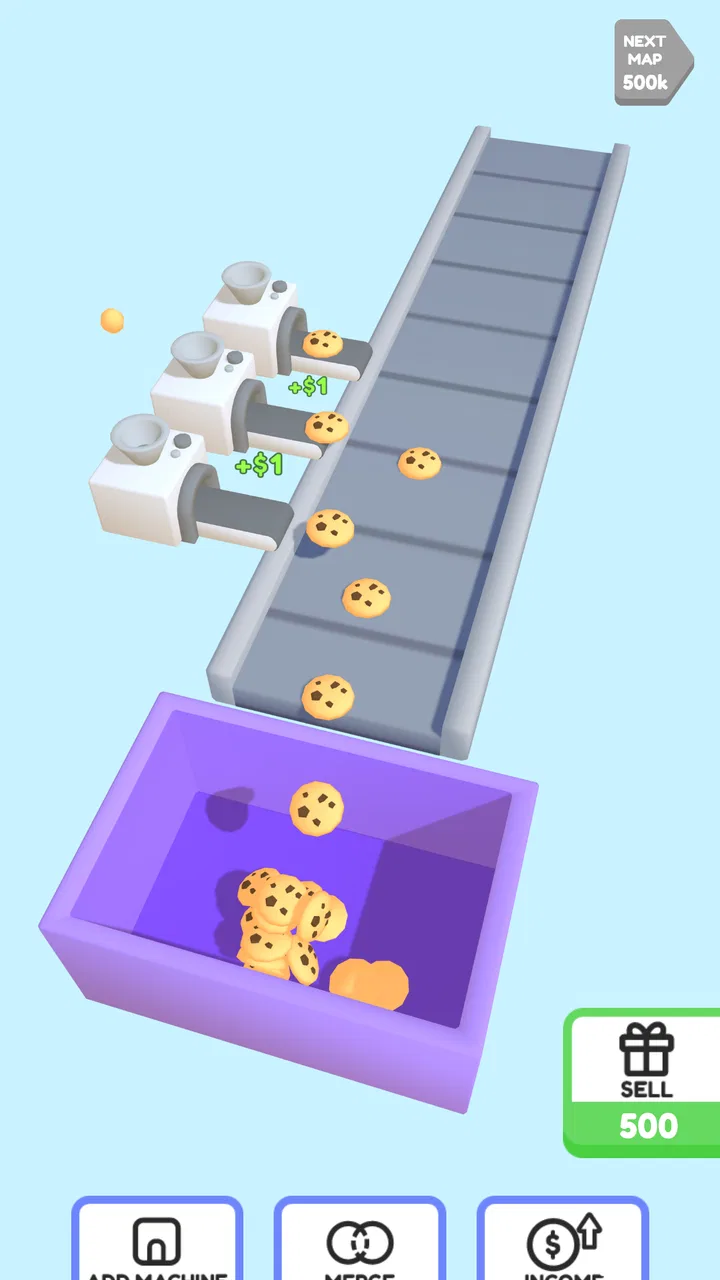
Dessert Factory Idle
- 4.7
- Rating
- 10.00M
- Installs
- Free
- Price

 Analysis by App-foxy
I spent time with Dessert Factory Idle expecting a simple arcade distraction, and that is exactly where it works best. This is a light, repetitive cookie-making game from Supercent, Inc. where the central pleasure comes from watching a dessert operation fill, improve, and keep moving. It is free to download, aimed at Everyone, and easy to understand within moments, but it also has enough small decisions to make the routine feel more satisfying than a completely hands-off idle game.
The basic idea is charmingly direct: produce cookies, build up your dessert output, and use the results to keep the factory progressing. There is no complicated story to learn before playing, and the presentation focuses on the cheerful factory loop rather than heavy menus or demanding strategy. I found it especially comfortable for short sessions because I could make progress without needing to remember a large set of rules.
That simplicity is also the most important thing to understand before installing it. This is not a deep management simulator, a competitive arcade challenge, or a baking game based on precise recipes. It is a casual idle experience built around repetition and gradual improvement. If that sounds relaxing rather than limited, you will probably understand its appeal quickly.
You May Also Like

 Blood Strike: 2.5 Anniversary
Blood Strike’s Loadouts Turn Every Drop Into a Tactical Gamble
A close look at Blood Strike’s custom loadouts: how fast access to signature weapons reshapes its battle royale rhythm, rewards preparation, and narrows the gap between fights.

 Pandora - Music & Podcasts
Pandora’s Music Is Easy to Start, but Harder to Recover
Pandora’s strength is its low-effort path from a seed to a station. Its weak spot is how much confidence it asks you to place in connection, setup, and quiet recovery.

 8 Ball Pool
 Is Built on Rivalries, Rematches, and Routine
A close look at the rivalries, rematches, shared routines, and unanswered safety questions that turn a quick pool match into a persistent mobile community.

 Samsung Music
’s Quiet Strength Is Playing What You Already Own
Its reach comes less from spectacle than from dependable access to a personal library. That simplicity is both the app’s strongest retention engine and its ceiling.

 AccuWeather: Weather Radar
AccuWeather Review: A Quick, Clear Forecast for Everyday Decisions
For everyday plans, the best forecast is the one you can understand quickly. AccuWeather makes rain timing, radar, and local conditions easy to act on, with a few trade-offs.

 Hill Climb Racing
Why Hill Climb Racing Still Turns Crashes Into One More Run
A tiny car, a bumpy hill and one more upgrade: Hill Climb Racing keeps resurfacing because its simple chaos makes every near-miss feel personal.
More From Our News Desk



How the cookie factory loop feels in everyday play
My usual session begins with a quick check of the factory, collecting what has accumulated and looking for the next useful improvement. The game then becomes a cycle of checking progress, spending resources, and letting the operation continue. It is a good fit for the kind of spare moment when I want something interactive but do not want to commit to a long level or a demanding puzzle.
A realistic use case is a short break during the day. I can open the game, handle the available production decisions, and close it again without feeling that I have abandoned a complicated mission. Later, I return to see what has changed. That rhythm gives the idle design a practical advantage over many traditional arcade games, which often expect uninterrupted attention and quick reactions.
The cookie theme gives the routine a little personality. Filling a dessert box feels more rewarding than watching an abstract number rise, and the variety of cookie-focused goals helps the progression feel connected to the setting. The store summary describes an endless variety of cookie dessert, but I would describe the real experience more modestly: it is a pleasant production loop with a dessert wrapper, not a full baking workshop.
The controls and objectives are approachable enough for someone who rarely plays mobile games. I did not need a tutorial-heavy mindset to understand what the game wanted me to do. That makes it suitable for younger players as well as adults looking for something gentle. The Everyone content rating supports that broad audience, although parents should still remember that optional in-app purchases are part of the experience.
One useful habit is to avoid spending every available resource immediately just because an upgrade is visible. I found it more comfortable to pause briefly and consider whether the improvement will help the part of the factory I am currently using most. In an idle game, a small upgrade that improves the active bottleneck is usually more satisfying than spreading resources thinly across every available option.
This is where the game has a little more thought than its bright presentation suggests. The decisions are not difficult, but timing matters to the feeling of progress. If I collect and upgrade without paying attention, the game still functions; if I make each visit purposeful, the same loop feels less automatic and more like a small routine I am managing.
Settings and habits that make short sessions smoother
There are no settings I would treat as a reason to install the game, but I still recommend checking the available options when you first open it. In particular, I like to review sound and notification preferences before settling into regular play. A factory idle game can be enjoyable with sound on when I am actively playing, yet unnecessary alerts or effects can become distracting when the game is only part of a busy day.
I also suggest checking the device’s own notification controls if you prefer a quiet phone. This is a simple but useful distinction: the game’s play loop and the phone’s interruption habits are separate things. Keeping notifications under control makes it easier to use the app as a deliberate break instead of feeling pulled back into it.
Battery and data awareness are worth considering too. I do not keep any idle game open constantly just to watch it work. I make a visit, collect what is ready, make a decision, and leave. That approach is more comfortable on a phone and prevents the game from taking over attention simply because it is designed around waiting.
For younger players, I would also look at purchase protections on the device before handing over the phone. Dessert Factory Idle is free, but individual in-app purchases range from ninety-nine cents to six dollars and ninety-nine cents. The amounts may seem manageable in isolation, yet repeated optional purchases can change the cost of a supposedly free game. A password or approval requirement is a sensible safeguard.
Another setting-related habit is to play with the interface at the size and brightness that feel comfortable rather than treating the game as something that must be played at maximum visual intensity. The factory is easy to appreciate without turning the screen into a distraction. That matters if you are using it in the evening or during a short break in a shared space.
Repeatable patterns that improve the factory routine
Experienced play here is less about secret techniques and more about consistency. I get better results from following the same order each time: inspect the current production state, collect what is ready, identify the most useful next improvement, and only then spend what remains. This prevents the common idle-game mistake of tapping through every available choice without noticing which one actually supports the current bottleneck.
A second helpful pattern is to separate active sessions from waiting sessions. During an active visit, I pay attention to the factory and make several decisions. During a waiting session, I simply leave the game to progress and return later. Mixing those two mindsets can make the game feel oddly slow, because I start expecting constant interaction from a design that is meant to reward patience.
I also prefer setting a personal stopping point. For example, I might finish one sensible upgrade cycle and close the app rather than continuing to check repeatedly. This does not change the game’s mechanics, but it improves the experience because the idle loop stays in its proper role: a small source of progress, not an obligation.
When resources are limited, I would prioritize the improvement that makes the next few visits feel clearer or more productive instead of chasing every visible option. That is a transferable habit for this particular factory: focus on what helps the current cookie flow, then reassess after the next collection. It keeps decisions readable and reduces the feeling that progress is random.
There is also a practical reason to avoid constant tapping. The appeal comes from seeing the factory develop over time, not from treating every moment as a speed test. If I rush through the interface, I lose the relaxed pacing that makes this arcade game pleasant. A calm, repeatable routine is more effective than trying to force excitement into an idle structure.
For players who enjoy light optimization, I recommend keeping mental notes about what you changed on the previous visit. You do not need a spreadsheet for this game. Simply remembering whether the last improvement made the factory feel faster or more balanced is enough to guide the next decision. That small pause turns passive progression into a manageable experiment.
Where the progression is enjoyable and where it stops
The strongest part of Dessert Factory Idle is its accessibility. It does not ask me to memorize complicated recipes, coordinate several characters, or react perfectly under pressure. I can pick it up after time away and understand the current situation quickly. That makes it a good companion game for commuting, waiting rooms, or a few quiet minutes between tasks.
It is also a reasonable choice for someone who likes the visual satisfaction of building a themed operation but does not want the complexity of a traditional tycoon game. Compared with a full management simulator, this focuses on a much narrower loop. There are fewer systems to balance, which means less mental overhead but also less room for long-term planning.
Compared with a standard arcade game, the trade-off is even clearer. A conventional arcade title may offer sharper challenge, faster reactions, and a stronger sense of personal performance. This game instead gives me gradual progress and a forgiving pace. If I want to test reflexes or chase a difficult score, I would choose another kind of arcade experience. If I want to check a growing cookie operation while relaxing, this is the better match.
The limitation is that repetition can become noticeable. Once the basic routine is familiar, the pleasure depends heavily on whether I enjoy incremental progress for its own sake. Players who need frequent new mechanics, demanding objectives, or a strong narrative may find the factory loop too narrow. The dessert theme is inviting, but it cannot by itself provide the depth of a large simulation.
Another trade-off is the free-to-play structure. The game costs nothing to start, which makes trying it easy, but the presence of optional purchases means I would not recommend approaching it with a “buy whatever speeds things up” attitude. I prefer treating purchases as entirely optional and judging the game by the free routine first. If the basic loop is not enjoyable without spending, extra items are unlikely to solve that problem.
The game’s broad audience is a strength, but it also signals that the experience is intentionally gentle. Its Everyone rating makes it approachable, yet players looking for mature themes or intense competition should not expect them here. The same friendly design that helps beginners may feel too restrained for people who want pressure and complexity.
What the version and popularity mean for a new player
The current version is 8.3.0, and the game requires Android 6.0 or later. That makes the compatibility requirement fairly approachable for many Android users, although I would still check the operating system on an older device before trying to install it. A compatible phone does not automatically guarantee that every player will enjoy the idle format, so the more important question is whether you like slow, repeatable progression.
Its scale is reassuring for anyone who prefers established mobile games: Dessert Factory Idle has passed ten million installs, with an average rating of 4.7 from around eighty-one thousand ratings and roughly one and a half thousand written reviews. Those figures suggest that the central loop connects with a large audience, but they should not replace personal judgment. Popularity confirms that the concept works for many people; it does not make the repetition disappear for someone who dislikes idle games.
The game was released on November 11, 2022, and the current version shows that it has continued as an active product rather than remaining a one-off experiment. I would still approach updates practically: install the latest available version, check that the phone meets the requirement, and allow time for the game to settle into its normal routine before deciding whether it belongs on your home screen.
Supercent, Inc. keeps the identity focused on a simple dessert factory rather than trying to turn it into an all-purpose game. That focus is helpful. I always know what kind of experience I am opening, and I do not have to switch between unrelated modes to find the enjoyable part. The downside is that anyone hoping for a broad collection of cookie-themed mini-games may find the scope more limited than the dessert setting suggests.
Who should play it, and who should choose something else
I would recommend it to casual players who enjoy watching small improvements accumulate, especially people who want a game that can be opened and closed without losing the thread. It also suits players who like food-themed presentation, gentle management choices, and a clear loop that does not require a long uninterrupted session.
It can work well for a child or family member who is new to mobile games, provided purchase controls are handled responsibly. The controls are approachable, the theme is friendly, and the Everyone rating makes the intended audience broad. I would still explain that free installation does not mean every optional item is free, particularly if the device is shared.
I would skip it if your main reason for playing arcade games is challenge. There is no point choosing a relaxed cookie factory when what you really want is rapid reaction, difficult timing, or competitive scoring. I would also look elsewhere if you prefer games with deep economic planning, extensive customization, or a story that drives every session.
It is not the right choice for someone who feels uncomfortable with idle mechanics in general. The game asks you to accept waiting and gradual accumulation as part of the fun. If that sounds like filler rather than progress, a level-based arcade game will probably feel more rewarding. On the other hand, if you enjoy checking a project, improving it, and returning later, the pacing makes sense.
My verdict after settling into the routine
After playing it as intended, I see Dessert Factory Idle as a polished example of a narrow idea done in an approachable way. It does not try to be a demanding simulator or a high-pressure arcade contest. Instead, it gives me a friendly cookie factory, a manageable sequence of improvements, and a reason to return for short visits.
My best advice is to treat it as a small habit rather than a game that deserves constant attention. Check the factory, collect deliberately, improve the part that needs help, and leave it alone until you genuinely want another visit. That approach makes the idle design feel rewarding and avoids turning the repetition into a chore.
The main question is not whether it has enough content for every type of player; it clearly will not. The question is whether its focused loop matches your idea of relaxing play. For me, it works when I want a cheerful, low-pressure break and do not need every session to deliver a new challenge.
My final recommendation: try it if you like incremental arcade progress and dessert-themed presentation, but keep your expectations centered on a simple factory routine. It is free to start, accessible to a wide audience, and easy to fit around daily life. Just remember that its charm comes from steady repetition, while its biggest weakness is the same thing: once that repetition stops feeling satisfying, there is not a deeper management game underneath waiting to take over.
FAQs for Dessert Factory Idle
01What is Dessert Factory Idle?
Dessert Factory Idle is a simulation game where players manage a dessert factory. You start with basic dessert production and gradually upgrade your equipment and recipes to expand your factory. The goal is to optimize production and maximize profits while unlocking new desserts and factory features.
02How do I progress in Dessert Factory Idle?
Progression in Dessert Factory Idle involves upgrading machines, unlocking new recipes, and expanding your production line. You earn money by selling desserts, which can be reinvested into improving efficiency. Completing tasks and achievements also provides rewards that help you advance faster.
03Are there in-app purchases in Dessert Factory Idle?
Yes, Dessert Factory Idle offers in-app purchases. Players can buy currency or special items to speed up their progress or unlock exclusive features. While purchases can enhance gameplay, the game is designed to be enjoyable without spending money, allowing players to progress at their own pace.
04Is an internet connection required to play Dessert Factory Idle?
Dessert Factory Idle can be played offline, allowing you to manage your factory without an internet connection. However, some features like leaderboards, events, or updates might require you to connect online. Playing offline won't hinder the core gameplay experience.
05What age group is Dessert Factory Idle suitable for?
Dessert Factory Idle is suitable for players aged 8 and above. Its colorful graphics and simple mechanics make it accessible for younger audiences, while the strategic elements keep it engaging for older players. Parents can feel comfortable with its content, as it contains no explicit material.
Pros
- Engaging gameplay with incremental progress.
- Vibrant graphics and colorful design.
- Simple mechanics suitable for all ages.
- Offline play available
- no constant internet needed.
- Frequent updates with new desserts and features.
Cons
- Ads can be intrusive and frequent.
- Progress may feel slow without in-app purchases.
- Limited customization options for factories.
- Repetitive tasks may become monotonous.
- Some features locked behind paywalls.

Dessert Factory Idle
Gallery